

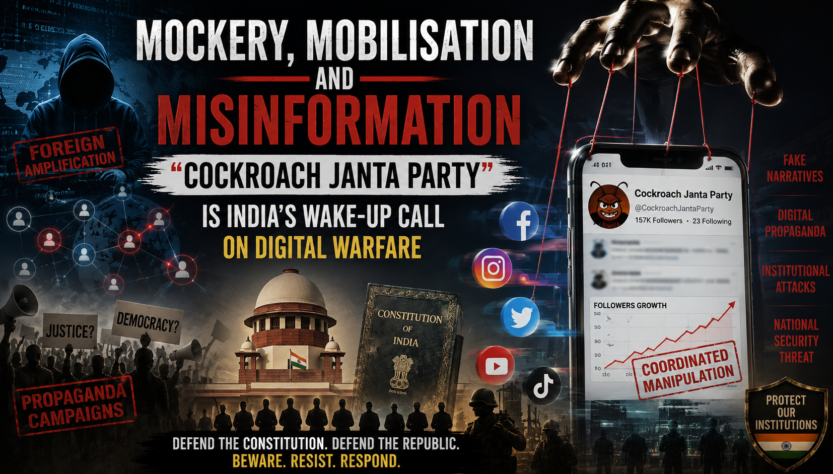
The viral rise of the “Cockroach Janta Party” is not merely a social media episode. It is a warning signal on digital influence operations, political mobilisation, foreign amplification and the targeted weakening of constitutional institutions.
India is today facing a new kind of national security challenge. It does not always come through borders, weapons, armed formations or conventional espionage. It increasingly enters through mobile screens, anonymous handles, meme pages, satire accounts, influencer networks and politically charged digital campaigns. These ecosystems do not merely spread opinion. In carefully designed circumstances, they can manufacture anger, weaken public trust, distort institutional legitimacy and create the impression of mass public revolt.
The recent rise of the so-called “Cockroach Janta Party,” founded by Abhijeet Dipke, must not be dismissed as a routine act of online mockery or political humour. It deserves to be examined as a serious case study in digital age political mobilisation, where satire, outrage, institutional criticism and algorithm-driven amplification can rapidly merge into a larger public-influence operation.
What makes the development more significant is the extraordinary speed at which the parody political movement gained visibility. Within days of its emergence, it reportedly crossed nearly 15 million Instagram followers, an unusual scale of growth even for established political organisations and public movements. Such rapid digital expansion raises legitimate questions about the nature of its amplification, the networks supporting its spread, and the forces shaping its political messaging.
No democracy should fear criticism. Citizens have the right to question governments, institutions and public authorities. But the line between democratic criticism and hostile information operation must be clearly understood. When a newly emerged digital handle grows at abnormal speed, targets a constitutional authority, converts a judicial clarification into a mass mobilisation weapon, and is surrounded by claims of foreign traction and political linkages, it becomes a matter for serious state level scrutiny.
The first and most serious issue is the attempt to weaken institutional legitimacy. The controversy began when remarks attributed to Hon’ble CJI Justice Surya Kant were widely circulated online without proper context. The CJI later clarified that his comments were misquoted and were aimed only at individuals using fake or bogus degrees, not at India’s youth. He also stated that India’s youth are the pillars of a developed India.
Despite this clarification, the distorted narrative continued, turning a judicial observation into a campaign against the Supreme Court and the Chief Justice. This makes the issue larger than criticism, it becomes an attempt to erode public faith in a key pillar of the Constitution.
The Supreme Court is not merely another public office. It is one of the central pillars of the Indian constitutional system. To criticise a judgment is democratic. To question judicial reasoning is legitimate. But to create a personalised, contemptuous, viral campaign against the office of the Chief Justice can have consequences far beyond humour or satire.
The second issue is the reported political connection. Abhijeet Dipke, identified as the founder of the Cockroach Janta Party, had earlier association with the Aam Aadmi Party ecosystem and that old posts connected to AAP leader Manish Sisodia surfaced online.
India must ask: is this purely satire, or political communication disguised as satire? Is it organic youth anger, or structured mobilisation? Is it a public response to judicial language, or an attempt to weaponise institutional mistrust for political gain? These questions are not accusations. They are necessary questions in a democracy that takes information security seriously.
The third major concern is the claim of foreign amplification. Social media posts have alleged that the handle’s audience is largely non-Indian, with Pakistan at 49%, the United States at 14%, Bangladesh at 14%, and India at only 9%. These figures are not independently verified yet. However, if even partly accurate, they raise serious questions about foreign influence in Indian political discourse and require immediate technical investigation by platforms and agencies.
The Government of India and appropriate investigative agencies must seek detailed information from digital platforms, including administrator locations, login history, audience geography, ad spend records, sudden follower spikes, bot like patterns, coordinated sharing networks, paid influencer activity and possible cross platform amplification. Without such technical verification, the truth will remain hidden between two extremes: those who call everything propaganda and those who call every investigation censorship.
The fourth issue is the wider geopolitical pattern. Around the world, foreign information manipulation and interference are now recognised as threats to democratic institutions. International IDEA has noted that foreign information manipulation can exploit domestic vulnerabilities and polarisation, while research on information warfare has repeatedly shown that social media platforms allow influence campaigns to operate at scale and speed.
India cannot afford to be naive. Modern hostile activity does not always announce itself as foreign interference. It often uses domestic fault lines, local grievances and emotional triggers. Unemployment, youth anger, judicial language, political frustration and media distrust can all become raw material. A hostile ecosystem does not need to invent public anger. It only needs to identify it, amplify it, distort it and direct it against institutions.
The fifth issue is the Bangladesh lesson. Bangladesh’s 2024 political crisis showed how digital mobilisation, public anger, disinformation, street unrest and institutional mistrust can combine into a dangerous national situation. Studies examining Bangladesh’s July 2024 uprising have highlighted the role of disinformation, social media analytics and digital battlefields in shaping protest mobilisation and political narratives. Council on Foreign Relations also noted how Bangladesh’s political and social fabric suffered severe damage during the protest crisis.
India is not Bangladesh. India’s constitutional system is deeper, its institutions are stronger, and its democratic experience is wider. But that is precisely why India must act early. Nations do not collapse suddenly. They are weakened slowly first through mistrust, then through delegitimisation, then through contempt for institutions, and finally through street level disorder justified as moral outrage. If the judiciary, Parliament, Election Commission, armed forces, investigating agencies and constitutional authorities are continuously portrayed as enemies of the people, then the ground is prepared for instability.
This does not mean suppressing dissent. A mature republic must tolerate criticism. But it must not tolerate covert manipulation. Freedom of speech cannot become a shield for coordinated foreign interference. Satire cannot become a cover for institutional defamation. Political activism cannot become a route for foreign backed destabilisation. And digital platforms cannot be allowed to function as unregulated theatres of psychological operations.
Therefore, a structured investigation is necessary. It should not be driven by emotion, party loyalty or public anger. It must be procedural, evidence based and legally sound.
As a veteran and cyber security expert my recommendations are:
First, the Ministry of Home Affairs, Ministry of Electronics and Information Technology, and relevant cyber agencies should conduct a preliminary technical assessment of the account’s digital behaviour.
Second, platforms such as Meta and X must be asked to preserve and provide relevant data under due legal process.
Third, if foreign origin coordinated amplification is found, the matter should be escalated to national security agencies.
Fourth, if funding links, political direction or paid propaganda networks are discovered, they must be investigated under applicable laws.
Fifth, if contemptuous or defamatory content targeting the Supreme Court and the Chief Justice crosses legal boundaries, appropriate legal proceedings must be initiated.
Recommended Policy and Countermeasures
- Create a National Digital Influence Cell
Monitor foreign amplification, bots, propaganda networks and attacks on constitutional institutions. - Demand Platform Transparency
Social media platforms must share data on admin location, audience geography, ad spends, follower spikes and coordinated activity. - Probe Toolkit and Foreign Links
Investigate political backing, proxy funding, paid promotion, foreign involvement and coordinated digital operations. - Protect Constitutional Institutions
Allow fair criticism, but act firmly against deliberate defamation of the Supreme Court, CJI, Armed Forces and Election Commission. - Build Rapid Counter Narratives
Issue quick clarifications, fact checks and public awareness campaigns before false narratives damage national trust.
The Cockroach Janta Party episode should therefore be treated as a red flag event. It may also reveal political orchestration or foreign amplification. Only investigation can establish the truth. But ignoring it would be irresponsible.
India must not wait for digital disorder to become street disorder. It must not wait for institutional mockery to become institutional collapse. It must not wait for foreign amplification to become foreign interference. The correct response is not panic. The correct response is investigation, exposure, regulation and democratic resilience.
India welcomes criticism, dissent and debate, but not hostile ecosystems hiding behind comedy or activism to weaken the Constitution. A sovereign republic must defend its pillars before they are shaken.